
Articles on Fabrics & Materials
T-Shirt Weight Explained: What 4.2oz vs. 6oz Actually Means
Aug 17th 2026
Every blank t-shirt label lists a weight in ounces — 4.2oz, 5.3oz, 6oz — and most people skip right past it on their way to color and size. That's a mistake if you're ordering for print or embroidery, because fabric weight changes how ink sits on the shirt, how clean an embroidered logo comes out, and how the shirt wears over a hundred washes. Here's what that number is actually measuring, and how to use it.
What "Weight" Is Actually Measuring
Fabric weight is measured in ounces per square yard (oz/yd²) in the US, or grams per square meter (GSM) almost everywhere else — a swatch of the fabric gets cut to a known size and weighed, full stop. One ounce per square yard works out to about 34 GSM, so a 5.3oz shirt and a 180 GSM shirt are describing roughly the same fabric.
What the number doesn't tell you directly is yarn thickness or knit density, even though both drive it. A tightly knit fabric made from finer yarn can land at a similar weight to a looser knit made from thicker yarn — they'll feel different in your hand even at the same ounce count. That's why weight is a useful shorthand but not the whole story; it's worth knowing what's behind the number on a shirt you're ordering in bulk.
The Range, With Real Shirts to Compare

Lightweight (around 4–4.5oz): the BELLA+CANVAS BC3001 comes in at 4.2oz using 32 singles yarn — a finer, more tightly spun combed and ring-spun cotton than what you'll find in most bulk blanks. Finer yarn is what gives lightweight tees their soft, almost worn-in hand feel straight out of the bag. It drapes closer to the body and breathes better, which is why retail and lifestyle brands lean toward this range.

Midweight (around 5–5.5oz): the Gildan 5000 at 5.3oz is the workhorse of this range — enough substance to hold a print or a stitched logo cleanly without feeling stiff. If you only stock one weight for bulk screen printing, this is usually it.
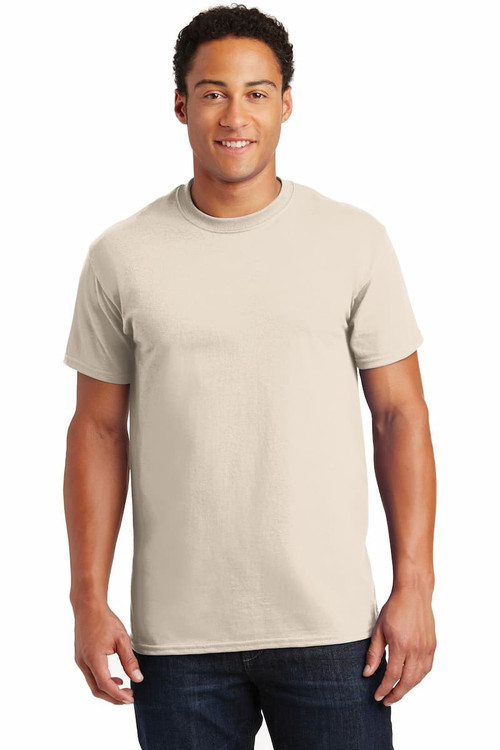
Heavyweight (6oz and up): the Gildan 2000 steps up to a full 6oz. More fabric per square yard means more abrasion resistance and a shirt that holds its shape through repeated industrial washing — the tradeoff is less drape and a warmer, boxier feel.
How Weight Changes What Happens When You Print It
Screen printing pushes ink into the surface of the fabric, and how much the fabric moves and stretches under that pressure depends on weight. Heavier fabric holds its shape on the platen, which means less risk of the print cracking or shifting during the run. It's also more forgiving with dark ink on light shirts or light ink on dark shirts, since a denser knit gives the ink less fabric texture to show through. Lightweight shirts can absolutely be screen printed well — it's just less margin for error, and it's part of why a soft 4.2oz tee sometimes prints with a slightly more visible "hand" than a midweight one.
How Weight Changes What Happens When You Embroider It
Embroidery puts real mechanical stress on fabric — needles punching through it thousands of times per minute while it's pulled tight in a hoop. Lighter fabric is more prone to puckering around a dense logo unless it's backed properly, which is the entire reason stabilizer backing exists in the first place. If you're ordering lightweight shirts for a heavily embroidered design, read up on how embroidery backing works before you commit to a design file — the backing choice matters more on a 4.2oz shirt than it does on a 6oz one, where the fabric itself does more of that work.
Picking a Weight by What You're Actually Doing
For a one-color logo on a big event giveaway run, midweight cotton like the 5000 is the safe, economical default — it prints cleanly and holds up to being worn once and washed a dozen times over a few years. For a retail or brand-facing product where feel matters as much as the logo, lightweight ring-spun cotton is worth the upcharge. For daily workwear, uniforms, or anything that's going in an industrial wash cycle weekly, heavyweight cotton earns its keep in durability alone.
Common Questions
Does a heavier shirt always mean better quality?
Not necessarily — it means more durable and more opaque. A lightweight combed, ring-spun cotton like the BC3001 is a higher-quality yarn than a cheap heavyweight shirt made from coarser open-end cotton. Weight and quality are related but not the same thing.
Will a heavier shirt shrink less?
Only slightly, and it's really the fiber and construction driving that, not the weight itself. A preshrunk heavyweight and a preshrunk lightweight cotton shirt from the same mill will shrink by roughly the same percentage.
What weight should I pick if I'm not sure?
5–5.5oz midweight cotton is the right default for most print jobs — it's the range built to handle both screen printing and embroidery without requiring you to plan around the fabric's limits.
Find Your Weight
All three of these live in our Cotton T-Shirts collection, alongside the rest of the lightweight-to-heavyweight range if you want to compare more than three.