
ANSI/ISEA 107 Class 1 vs. 2 vs. 3: Which Hi-Vis Gear Do You Actually Need?
Aug 17th 2026
A worker in a bright orange vest looks compliant. Whether they actually are depends on a number most people never check: the ANSI/ISEA 107 Class printed on the tag. Class 1, 2, and 3 aren't marketing tiers — they're tied to specific amounts of visible material and specific traffic and hazard conditions, and wearing the wrong class can leave a crew technically out of compliance even though everyone's got hi-vis on. Here's what the classes actually mean and how to land on the right one.
What the Standard Actually Regulates
ANSI/ISEA 107 rates a garment on two separate things: Type and Class. Type describes the setting the garment is built for — Type O for off-road environments like warehouses and yards, Type R for roadway work exposed to public traffic, and Type P for public safety roles like fire and EMS, which allows contrasting accent colors for role identification that Type R doesn't. Class describes how much fluorescent background material and retroreflective tape the garment carries, which scales with how much risk the wearer is actually exposed to.
Class 1: Off-Road, Low Speed
Class 1 is the minimum tier, and it's only available in Type O garments — it's not rated for roadway work at all. It's meant for environments where traffic stays under 25 mph and there's real separation between workers and vehicles, like warehouse floors or parking lot attendants. It carries the least material of the three classes, which is the tradeoff for being rated for the lowest-risk setting.
Class 2: Moderate Risk, Roadway Proximity

Class 2, like the CornerStone CSV100 vest, steps up to roughly 201 square inches of retroreflective tape and is built for traffic in the 25–50 mph range, or lower-speed conditions with reduced visibility from weather. One detail that trips people up: a Class 2 vest only meets the standard when it's fully closed. An unzipped or unfastened vest breaks up the required 360-degree visibility around the body, which technically drops it out of compliance even though it's the "right" garment.
Class 3: High Speed, Full-Body Visibility
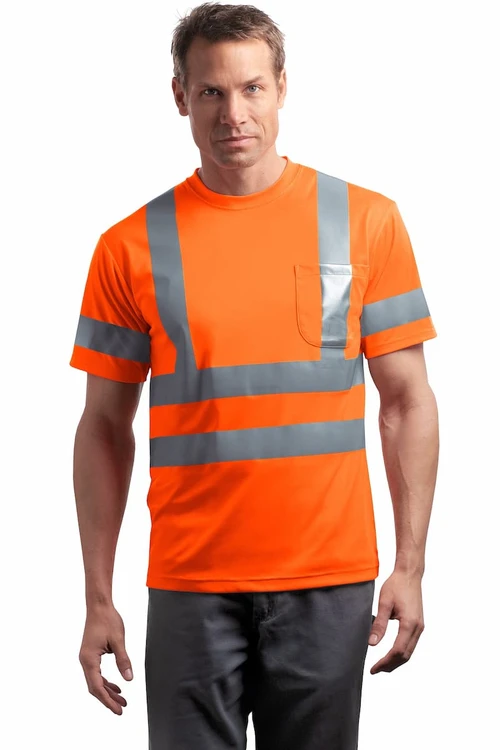
Class 3 is the highest tier, required for traffic over 50 mph or complex, low-visibility environments like night work or heavy equipment operation. It needs roughly 310 square inches of retroreflective tape and, critically, has to outline the wearer's silhouette from a distance — which is why a Class 3 garment always covers the arms, not just the torso. The CornerStone CS408 carries its 2-inch reflective taping across the front, back, and sleeves for exactly this reason — a Class 3 vest layered over a plain shirt doesn't give you that arm visibility, only a Class 3 shirt or jacket does.
The One Federal Rule Worth Knowing
If your crew works within the right-of-way of a federal-aid highway, the Manual on Uniform Traffic Control Devices sets a real floor: Class 2 or Class 3 apparel is required, no exceptions for Class 1. That's one of the few places the class requirement is spelled out by federal rule rather than left to a general hazard assessment, which is exactly why road crews are almost never issued Class 1 gear.
How to Pick the Right Class
- Warehouse, yard, or parking lot work with no roadway exposure — Class 1 is typically sufficient.
- Utility, delivery, or maintenance work near roadway traffic under 50 mph — Class 2.
- Road construction, flagging, or any work near traffic over 50 mph, or in low-light conditions — Class 3.
OSHA doesn't publish its own separate class system — it points employers to ANSI/ISEA 107 as the consensus standard for selecting PPE once a hazard assessment identifies a visibility risk. State, municipal, or site-specific rules can layer additional requirements on top of that baseline, so it's worth confirming the exact class your job site requires with your safety officer before ordering, especially for federal-aid highway work where the class is mandated outright.
Common Questions
Can a Class 2 vest worn over a Class 3 shirt count as Class 3?
No — class ratings apply to the specific garment as tested, not to a combination of layered pieces unless the manufacturer has specifically certified that combination together.
Does color matter for the class rating?
The standard requires fluorescent yellow-green, orange-red, or red background material, but the class itself is about quantity of material, not the specific shade — any of the approved colors can meet any class.
Do washed or faded hi-vis garments stay compliant?
No. Retroreflective tape loses effectiveness with wear and washing, and a garment with worn or peeling tape no longer meets its rated class even if it did when new — it's worth inspecting hi-vis gear periodically rather than assuming it's still compliant indefinitely.
Shop by Class
Browse the full range of Class 2 and Class 3 hi-vis apparel, from mesh vests to reflective tees to safety jackets, all clearly labeled by class.