

Articles on Fabrics & Materials
Poly-Cotton Blends for Uniforms: What the Ratio Actually Changes
Aug 17th 2026
Uniform shirts usually get judged on the price per unit, but that's the wrong number to optimize. A staff polo gets washed a hundred times or more over its life, and the cotton-to-poly ratio in the fabric is what actually determines whether it still looks presentable at wash 80 or has faded and gone limp by wash 30. That ratio is worth understanding before ordering fifty of anything.
What the Ratio Actually Controls
Cotton is comfortable and breathable, but it wrinkles easily and its dye fades measurably faster under the hot water and repeated agitation of frequent washing. Polyester holds its shape through a wash and dry cycle without ironing, and it holds dye color far longer than cotton does — but push the polyester percentage too high and a shirt starts to feel more like plastic than cloth, especially for anyone wearing it through a full shift. The ratio on the label is a direct tradeoff between those two things, and different roles genuinely need different points on that scale.
Real Examples Across the Range

The Port Authority K100 sits at 60/40 cotton/poly — cotton-forward, built for the softer, "lived-in" feel that makes sense for occasional wear or business-casual settings where the shirt isn't going through a wash cycle every single day.
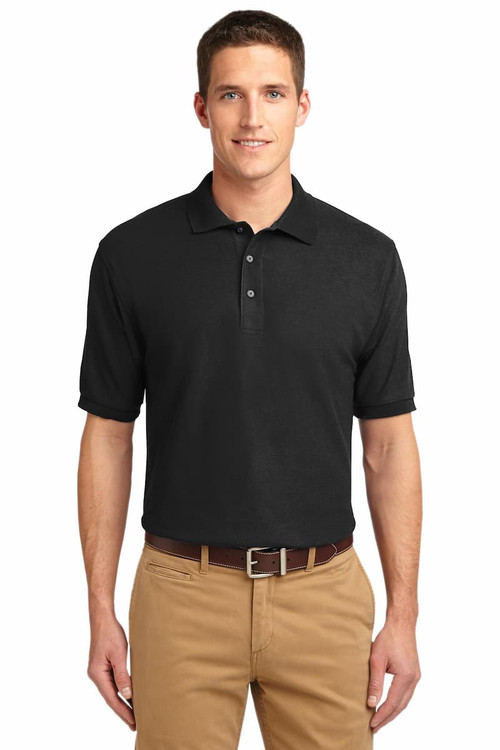
Flip the ratio and you get the Port Authority K500 at 65/35 poly/cotton — poly-forward, and rated for noticeably better wrinkle and shrink resistance as a direct result. That's the shirt built for a uniform program where staff are washing and re-wearing it daily and it needs to come out of the dryer ready to go without ironing.
Fiber Ratio and Finish Are Two Separate Decisions

The Port Authority K510 is worth pointing out specifically because it's the same 60/40 cotton/poly ratio as the K100, but with a stain-release and moisture-wicking finish added on top. That's the detail people miss: the base fiber ratio and any added performance finish are two separate levers, not one. You can have a cotton-forward blend with a stain-release treatment, or a poly-forward blend with none at all — the ratio tells you about wrinkle and shrink behavior, the finish tells you about stain and odor resistance, and a shirt's tag usually lists both separately for a reason.
The Cost-Per-Wear Math
A cheaper, cotton-heavy shirt that visibly fades or loses its shape after 30–40 washes and gets pulled from rotation is not actually the cheaper option once you count the reorder. A slightly pricier poly-forward shirt that still looks presentable after 100+ washes usually wins on cost per wear, even though it loses on the sticker price sitting side by side in a catalog. For any uniform program with daily wear and commercial laundering, that math is worth running before defaulting to the lowest per-unit price.
Picking by Role
- Daily-wash, customer-facing roles — a poly-forward blend like 65/35 for wrinkle resistance and better long-run color retention.
- Occasional wear or business-casual settings — a cotton-forward blend like 60/40 for softness, since it isn't in the wash-and-wear cycle daily.
- Food service or other stain-prone roles — look for a stain-release finish specifically, independent of the base ratio.
Common Questions
Does a higher poly percentage mean a hotter, less breathable shirt?
Somewhat, yes — it's a real tradeoff, which is why most uniform polos land in the 60/40 to 65/35 range rather than going heavily synthetic. That range keeps wrinkle resistance meaningfully better than pure cotton without giving up much breathability.
Will a stain-release finish wash out over time?
Most topical finishes do fade gradually over dozens of washes, though it happens slowly enough that it's rarely the reason a uniform shirt gets replaced — fading color and lost shape usually happen first.
Is 50/50 ever the right call for uniforms?
It can be, especially for lower-frequency wear, but for daily commercial laundering most uniform programs land better with the poly percentage at 40% or higher for the wrinkle and shrink resistance it adds.
Shop Uniform Polos
Browse the full range of easy-care polos, including options with stain-release and moisture-wicking finishes for daily-wear uniform programs.